Antelope Island State Park
Antelope Island Mammals
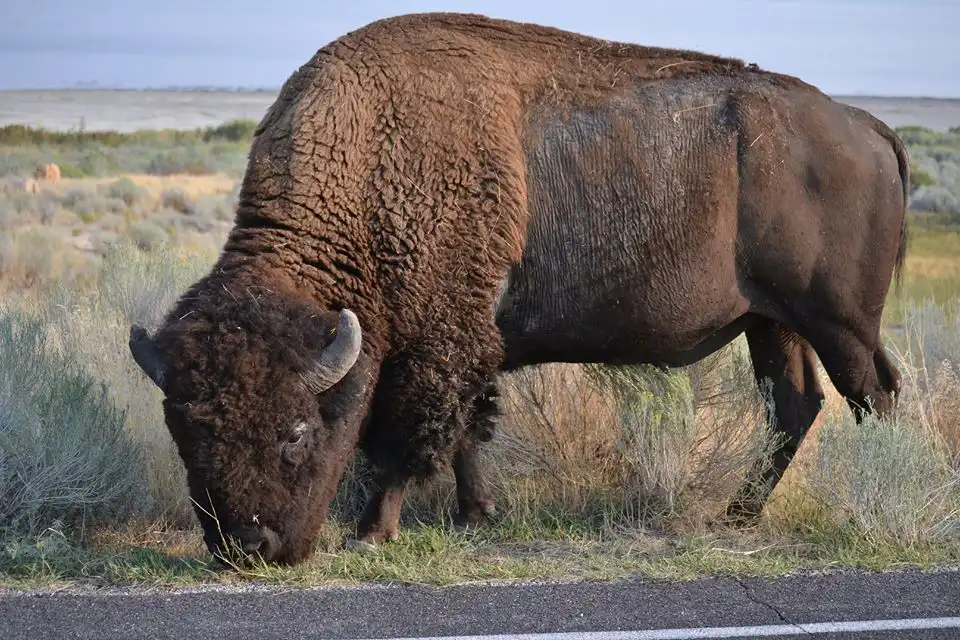
From bison, red fox, pronghorn, big horn sheep to coyotes and a variety of bats, we’ve got some fun facts on the mammals that call Antelope Island State Park home.
Fun Fact: Even though they are often called buffalo, they are actually not part of the buffalo family. Buffalo are usually found in Asia and Africa. We have North American bison.
Invertebrates
Mantispidae
Rare, nocturnal Mantispidae are related to lacewings, not wasps or praying mantises, despite their appearance. They mimic wasp stripes to confuse threats and use mantis-like front legs to snatch small insects. Unlike mantises, they cannot walk on their front legs, relying entirely on their four back legs for walking around.
Ambush Bug
Brightly colored and spiky, these “true bugs” camouflage among flowers to ambush prey. Harmless to humans, they are deadly to smaller creatures, capable of taking down victims up to ten times their size. Instead of mouths, they use a piercing beak to suck the juices from their catch.
Ten Lined June Beetle
Resembling a tiny watermelon, this large Western scarab features amber underbelly hairs and impressive, moose-like antennae that are larger in males. Following a long larval stage, adults live just weeks. Flightless and unable to bite, this harmless beetle deters predators by forcefully expelling air to create a startling hiss.
Skimmer Dragonfly
Robust skimmer dragonflies, like the neon and ten-spotted, are striking aerial acrobats. Territorial males and egg-laying females produce aquatic young called naiads, which outlive the adults. We appreciate these beneficial predators because they naturally consume many of the pesky biting insects that bother us.
Sand Wasp
Green-eyed sand wasps belong to a massive insect family that may even outnumber beetles. Mothers dig sandy desert burrows and hunt flies, feeding up to twenty to a single larva. While capable of stinging if grabbed, these helpful predators generally avoid humans, unlike bothersome yellow jackets.
Assassin Bug
The Aptera assassin bug is a predatory true bug whose species name means “without wings,” reflecting its frequently wingless state. Instead of undergoing complete metamorphosis, it starts as a little bug, repeatedly molting and growing until reaching adulthood. It uses a specialized beak to catch and consume its prey.
Brine Flies
Great Salt Lake brine flies are vital food for migratory birds. They survive the extreme environment using a specialized salt-removing organ. Larvae winter at the lake bottom, while adults live only days. For visitors: these swarms stay strictly at the water’s edge, completely disappearing once you wade in.
Jerusalem Cricket
Jerusalem crickets are memorable, wingless insects with spiny legs perfectly adapted for digging. They prefer living underground and are rarely seen due to their nocturnal, solitary habits. Their common name likely stems from a 19th-century expletive, which was a fitting reaction upon encountering these startling yet fascinating creatures.
Banded Argiope
Banded garden spiders are large, shy orb weavers building beautiful, concentric webs in tall vegetation. Though venomous, they pose absolutely no medical threat to humans. Females are significantly larger than the hidden males and typically rest quietly in the web’s center, positioned head down with their bellies facing south. Photo courtesy: Margie Nash
Western Spotted Orb Weaver
The most common spiders on Antelope Island, these harmless orb weavers build large round webs between objects like sagebrush. Shy by nature, they hide when approached. Larger females dominate the web’s center while smaller males hang aside. Abundant brine flies provide ample food, allowing them to thrive and share spaces.
Desert Orb Weaver
As the weather warms, these tiny orb weavers become abundant on Antelope Island. Though their abdominal patterns resemble the Western Spotted Orb Weaver, they are much smaller. These diminutive spiders build distinct nests and webs in tall grasses, rabbitbrush, and small crevices, often going unnoticed by visitors due to their size.
Cat-faced Spider
Named for two abdominal bumps resembling cat ears, the harmless cat-faced spider builds beautiful, concentric webs. Unlike other orb weavers, they wait patiently off to the side rather than in the center. While both sexes possess these characteristic “ears,” males are only about half the size of females. Photo courtesy: Margie Nash
Bold Jumping Spider
As one of Utah’s most common jumping spiders, this species belongs to a global family of over 5,000. Their venom is harmless to humans, making them safe neighbors. These spiders are extremely beneficial, acting as effective natural pest control by hunting various insects throughout our homes and gardens.
Crab Spider
The Goldenrod Crab Spider hides in flowers, camouflaging itself to ambush prey. Remarkably, it can change its color from white to bright yellow or green to match its surroundings, a process taking two to three days. While effective hunters, their venom is not medically significant or harmful to humans.
Western Black Widow
Black widows are the only medically significant spider in the USA. They have a neurotoxic venom that directly affects the nerves and nervous tissues of its victims. Death from a black widow bite is extremely rare and only occurs in individuals with other health risks.
Northern Scorpion
The northern scorpion is a bit of an overachiever—it is North America’s northernmost species, ranging into Canada. While most scorpions prefer southern deserts, these hardy arachnids thrive in Northern Utah’s rocky outcrops and sagebrush near the Great Salt Lake, proving their resilience in much cooler climates.
Camel Spider/Sun Scorpion
American Dog Tick (Wood Tick)
Birds of Antelope Island
Meet 20 of the most popular birds that call Antelope Island home.
Ruddy Duck
(Oxyura jamaicensis)
Arguably some of the cutest ducks ever, Ruddy Ducks are small divers that swim around with their tail held high! Males of this species have a fantastic display where they bash their breast with their bright blue bills, causing bubbles to form! Keep an eye out for thousands of these birds out in the waters off the causeway. This species is present year-round, with the highest numbers in winter.
Chukar
(Alectoris chukar)
Also known as the Indian Partridge, Chukar are sneaky ground birds that run through rocky areas throughout the island. Though introduced to the island and surrounding area, Chukar fit into this ecosystem well. Living in their multi-family groups, called coveys, they can be found in rocky areas like Ladyfinger Point, Buffalo Point, and the Visitor Center. This species is present year-round.
Rufous Hummingbird
(Selasphorus rufus)
These feisty little birds are orange fighting machines! They quickly take over any food sources near them, chasing off anything from another small hummingbird to massive eagles. Barbs on their bills help too, giving these little birds a nasty bite. Rufous Hummingbirds can be hard to spot due to their small stature, but can be seen around Fielding Garr Ranch, especially when flowers are in bloom August-September.
American Avocet
(Recurvirostra americana)
During the summer months, these rusty-headed birds visit the causeway in droves. Their distinctive up-turned bill is used to sift through Great Salt Lake’s mud to find invertebrate prey. In the winter, their rusty heads may go white, but the black-and-white of their wings still gives a spectacle! They tend to forage in large groups in shallow waters around the causeway year-round.
Long-billed Curlew
(Numenius americanus)
A long, downcurved bill is the distinctive feature of this large shorebird! Like many other shorebirds, their bills are highly specialized to find their prey. They probe their bill into the mud and sand, often eating all kinds of bugs and other invertebrates. Open fields and on the mudflats along the causeway are the best places to see these unique birds. This species is here March-November.
Wilson’s Phalarope
(Phalaropus tricolor)
Wilson’s Phalaropes make their 10,000-mile flight to Argentina every year after gorging themselves on the many flies and other invertebrates of Great Salt Lake. Hundreds of thousands of them visit the lake every year, but fewer breed here. Watch for their beautiful flocking behavior as they move around and over the causeway in the morning. This species is present April-November.
Eared Grebe
(Podiceps nigricollis)
Over 5 million Eared Grebes visit and feed on Great Salt Lake. Each bird sustains itself on nearly 30,000 brine shrimp per day! Their feet are so far back on their bodies that they can barely walk, so all their foraging is done on the water. During the summer, the deeper waters around the causeway can be speckled with hundreds of thousands of this diving bird. This species is present year-round.
Golden Eagle
(Aquila chrysaetos)
Common prey of this bird includes small mammals, birds, and on occasion, young pronghorn and coyotes! Golden Eagles are the 5th largest eagle in the world, and one of the most widespread and deadly predators on earth! They are sometimes called “booted eagles” due to their feathered legs! These massive birds are most seen at high elevations, including Frary Peak. They are present year-round.
Burrowing Owl
(Athene cunicularia)
Unlike most other owls, Burrowing Owls live on and in the ground! Their communities can be quite large, with many families living loosely together. Man-made burrows are scattered all over the island’s grasslands, where these birds often stand on tall plants near their homes. Keep an eye out for them as they fly low across the road. These birds are here year-round, with the majority present during summer.
American Kestrel
(Falco sparverius)
Though the smallest falcon in North America, American Kestrels are successful and widespread. Their remarkable eyesight helps set them apart as fantastic hunters! Kestrels can be found all over the island, but are best seen around Bridger Bay and Fielding Garr Ranch. Their unique tail-pumping and head-bobbing behaviors are easy to spot, even from afar. They are present on the island year-round.
Loggerhead Shrike
(Lanius ludovicianus)
These birds have an interesting caching technique where they will hang their prey from thorns and spikes so they can eat it later! This prey can be as large as the bird itself! Due to this behavior, shrikes are sometimes known as “butcherbirds!” Keep your eyes out on the top of sagebrush for the black masks of these master cachers! This species is here year-round.
Horned Lark
(Eremophila alpestris)
This hardy little bird lives not only in the beating sun of Antelope Island, but also on the tops of high-altitude peaks! If you’re lucky, you may be able to see their mating displays where they circle then dive, saving themselves just before hitting the ground! Though not actually horned, these birds have little tufts of feather that look just like horns! Make sure to watch the roadsides as these birds forage around the road! This species is present year-round.
Barn Swallow
(Hirundo rustica)
Cliff Swallows may be very similar to Barn Swallows, but Barns have a forked tail and a dark chevron on their foreheads. Just like Cliff Swallows, Barn Swallows pick up mud from puddles and shorelines to cement their nests! The best place to see these cuties is around the Visitor Center and inside the sheep barn at Fielding Garr Ranch. This species is present March-November.
Rock Wren
(Salpinctes obsoletus)
These adorable little birds love building “paved patios” in front of their hidey-holes! Due to the often hot and arid environments they live in, Rock Wrens are well adapted to water conservation. They don’t even need to drink! Their food, spiders, gives them just enough moisture! They are everywhere on the island that has rocks, especially Frary Peak, Ladyfinger Point, and around the Visitor Center! This species is present year-round.
Sage Thrasher
(Oreoscoptes montanus)
Nests of this species are well-adapted for hot environments, being placed eastward, capturing heat during the morning and staying cool in the afternoon. Sage Thrashers are easiest to find in sagebrush steppe across the island, primarily in the North. Keep your eyes out for their yellow eyes and streaked breasts, standing high on top of sagebrush shrubs! These birds are present March-October.
Western Meadowlark
(Sturnella neglecta)
Western Meadowlarks though called “Larks” are not actually larks, they’re Blackbirds! Western Meadowlarks are a beloved species across the United States, being the state bird of six different states! Keep your eyes out for these bright yellow birds singing their fantastic songs from high vantage points! They’re the reason all our signs have poop on them! They are present year-round.
Bullock’s Oriole
(Icterus bullockii)
Like other Orioles, these birds often eat insects, but when given the chance to eat fruit or nectar, will dig in! At home, hummingbird feeders may bring these birds in, though jellies, jams, and fruits are also good bait! On the island, Bullock’s Orioles are found jumping through the trees of Fielding Garr Ranch and the Mulberry Grove. This species is present May-August.
Red-winged Blackbird
(Agelaius phoeniceus)
Hearing a robot on the causeway? Well, that is either a Red-winged or Yellow-headed Blackbird! These birds are well known for being so territorial that they will even chase off ravens, hawks, and eagles! Red-winged Blackbirds often sit in the reeds on the sides of the causeway defending their territory from other neighboring birds! This species can be found on the causeway year-round.
Yellow-rumped Warbler
(Setophaga coronata)
Yellow- “rumped” Warbler may sound like a weird name, but it is perfect to describe this bird! The base of their tail, or their “rump” is a bright yellow color and is unique among most warblers. The best place to see these tiny birds is at Fielding Garr Ranch or flitting around the Mulberry Grove. They are present in high numbers during April-May and August-November.
Western Tanager
(Piranga ludoviciana)
Western Tanagers are the only Tanager that goes this far north. They are quite beautiful birds, having greatly contrasting black and white wings against a highlighter yellow body and cherry red head. They are a sight to see when they fly by! Females may have duller colors, but they are still nice to see! These bright birds are seen at Fielding Garr Ranch and in the Mulberry Grove May-September.
Conditions: View more park conditions
Hours: Open year-round: 6 a.m. – 10 p.m.
Closed: Thanksgiving and Christmas
Phone: 801-725-9263
Visitor Center
Hours: 9 a.m. – 5 p.m.
Fielding Garr Ranch Museum and Exhibit
Facilities Open: Daily 10 a.m. – 5 p.m.
Self-Guided: Outside of open hours
Management
Park Manager: Doranne Pittz
Assistant Park Manager: LeeAnn Burrill

57°F
L: 54°
H: 60°
Feels like 55°F°
clear sky
Daily Forecast
Hourly Forecast
Today
54° / 60°°F
0 mm
0%
6 mph
65 %
1018 mb
0 mm/h