Antelope Island State Park
American Bison
(bison bison)
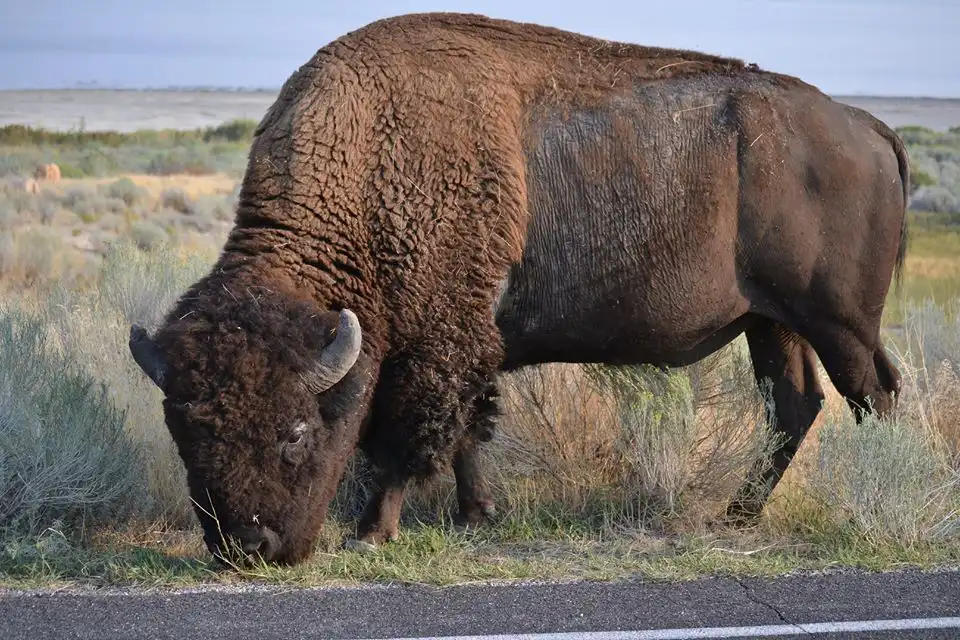
Description: Bison have long brown fur with a beard under their chin. They have tails with little tufts of hair on the end. They have big heads with black horns that they use to plow snow out of their way during winter, and as a battering ram in dominance fights or against predators. They have a hump on their shoulders that is made of pure muscle.
Fun Facts
- Bison can run up to 35mph.
- Even though they are often called buffalo, they are actually not part of the buffalo family. Buffalo are usually found in Asia and Africa. We have North American bison.
- Bison are nearsighted. They rely heavily on their great sense of smell and hearing.
- 12 bison were brought to Antelope Island in 1893 and today there are 550-700 bison on the island.
Pronghorn
(antilocapra americana)
Description: Pronghorn (a.k.a. antelope) have reddish-brown fur with areas of white on their stomach, rump, chest, throat, and facial area. Pronghorns are named and known for their pronged horns. Both male and females have black curving horns. Their horns have characteristics of antlers and horns. Pronghorns are the only mammals that shed their horns every year like antlers. Male horns can grow to 10 to 12 inches long with a forward-facing prong. Females have smaller straight horns.
Fun Facts
- Antelope Island was named after Pronghorns were seen grazing on the rangelands by John C. Fremont and Kit Carson in 1845.
- They can run up to 60-70mph. They are the second fastest running land mammal, the first is a cheetah (70 mph). However, pronghorn can run at that speed for much longer than a cheetah.
- Pronghorns have a layer of “hollow” hair that helps keep them warm during the winter. They shed this layer during the summer to stay cool.
- Pronghorns aren’t Antelope at all. Like the bison, they are misnamed. They are the sole survivor of the family: Antilocapridae.
Image Credit: Dave Holden

Bighorn Sheep
(ovis canadensis)
Description: Bighorn sheep have small, muscular bodies. They have brown fur, with white on their face and rumps and stomach. Males are known for large, curled horns. Males horns grow up to 3ft in length and 1ft in diameter at the base. Their horns can weigh up to 30lbs, which is more than all the bones in their body combined. Females also have horns, but much smaller.
Fun Facts
- When males fight for dominance, they “ram” their giant horns into each other. They can charge at 20mph.
- When they impact, the sound can be heard up to a mile away.
- They have split hooves that help them balance on steep, rocky terrain.
- Bighorn sheep groups protect themselves from predators by facing different directions, allowing them to keep watch on their surroundings.

Mule Deer
(odocoileus hemionus)
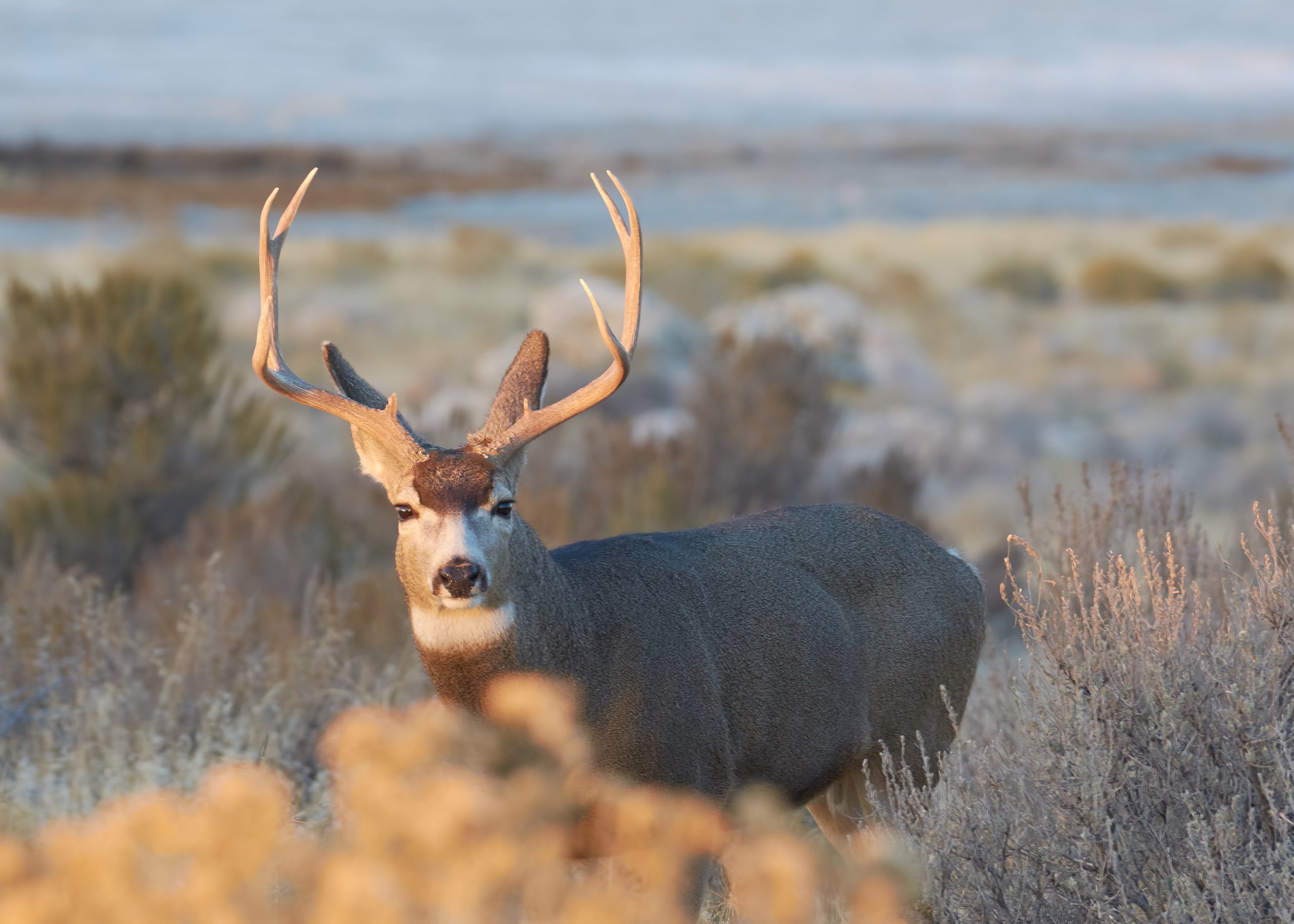
Description: Named for their mule-like ears that are about three-fourths the length of their head. They are able to move their ears independently, allowing them to listen for sounds of danger around them. They have tan-brown fur with a light gray face. They have white bums with a white tail and black tip. The males have antlers that shed every year.
Fun Facts
- Their antlers can grow up to one-fourth of an inch a day
- Their eyes are located on the side of their heads, giving them 310-degree vision.
- They can jump up to 8 feet high and 15 feet in distance.
- They can run up to 45mph.
- They have a unique leaping gait, where all four legs touch the ground at the same time while running.
Porcupine
(Erethizon dorsatum)
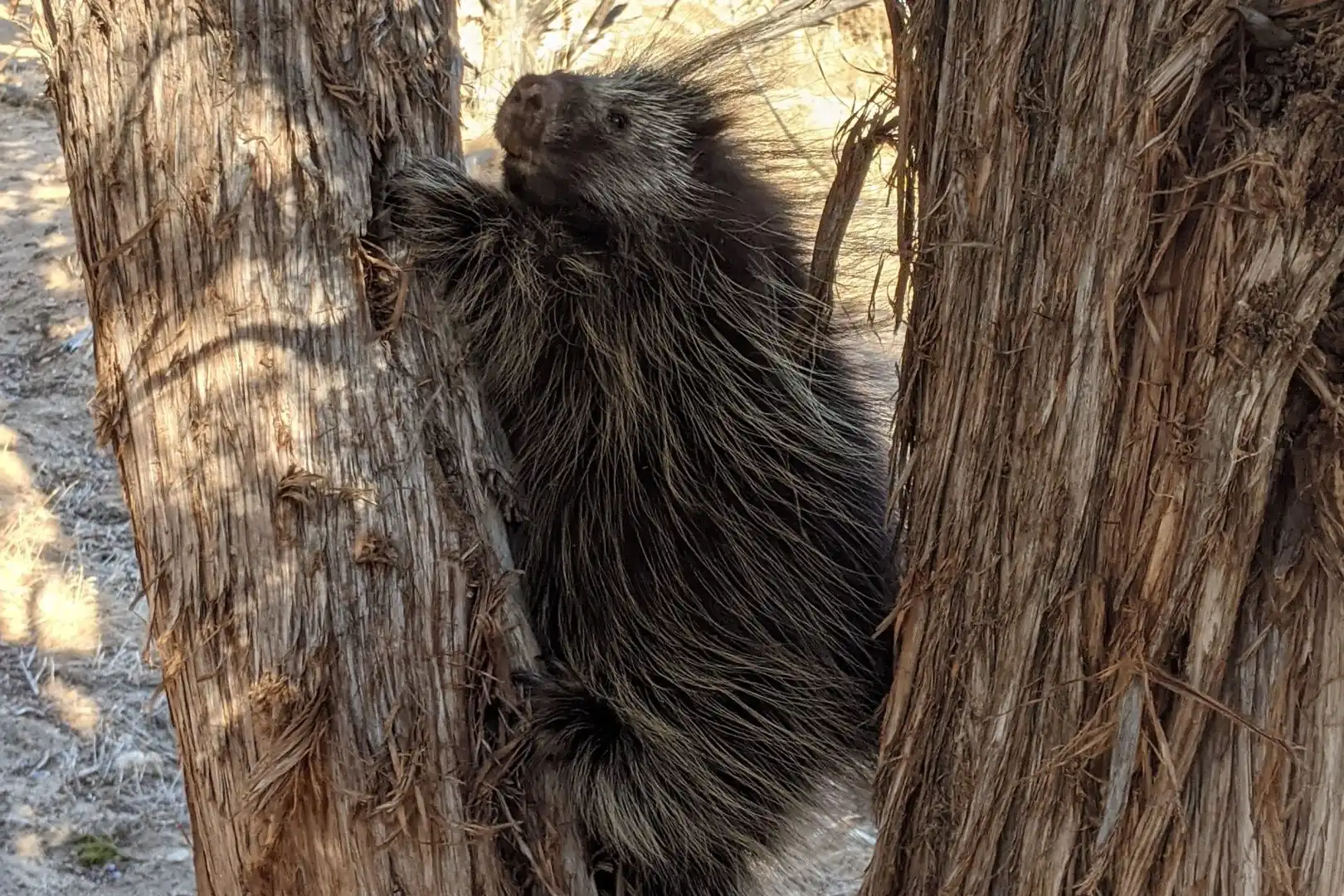
Description: The porcupine is in the rodent family. They have black, brown, and yellowish fur. They have short, strong legs. They have small round bodies, small ears, and a small head. They are most recognizable by their quills. Their Latin name translates to “quill pig” in English. They can have up to 30,000 quills. The quills have barbed tips and are mostly hollow. The quills, mixed with soft fur, are all over the porcupine’s body except their stomach, but longest on their rump. Porcupines don’t actually throw their quills. They turn around when a predator approaches, raise their quills and thrash around with its tail so the quills get stuck in the predator’s skin.
Fun Facts
- Porcupines are very vocal. They have calls that include grunts, coughs, whines, shrieks, and tooth clicking.
- When a porcupine loses a quill, it will grow a new one.
- Porcupines climb trees and eat the bark off the trees.
- Porcupines make dens. They don’t hibernate but they will hide in their dens during bad weather.
- The only rodent larger than a porcupine is a beaver.
- Porcupines are nocturnal, which means they are mainly active at night and sleep during the day.
Black-Tailed Jackrabbit
(lepus californium)
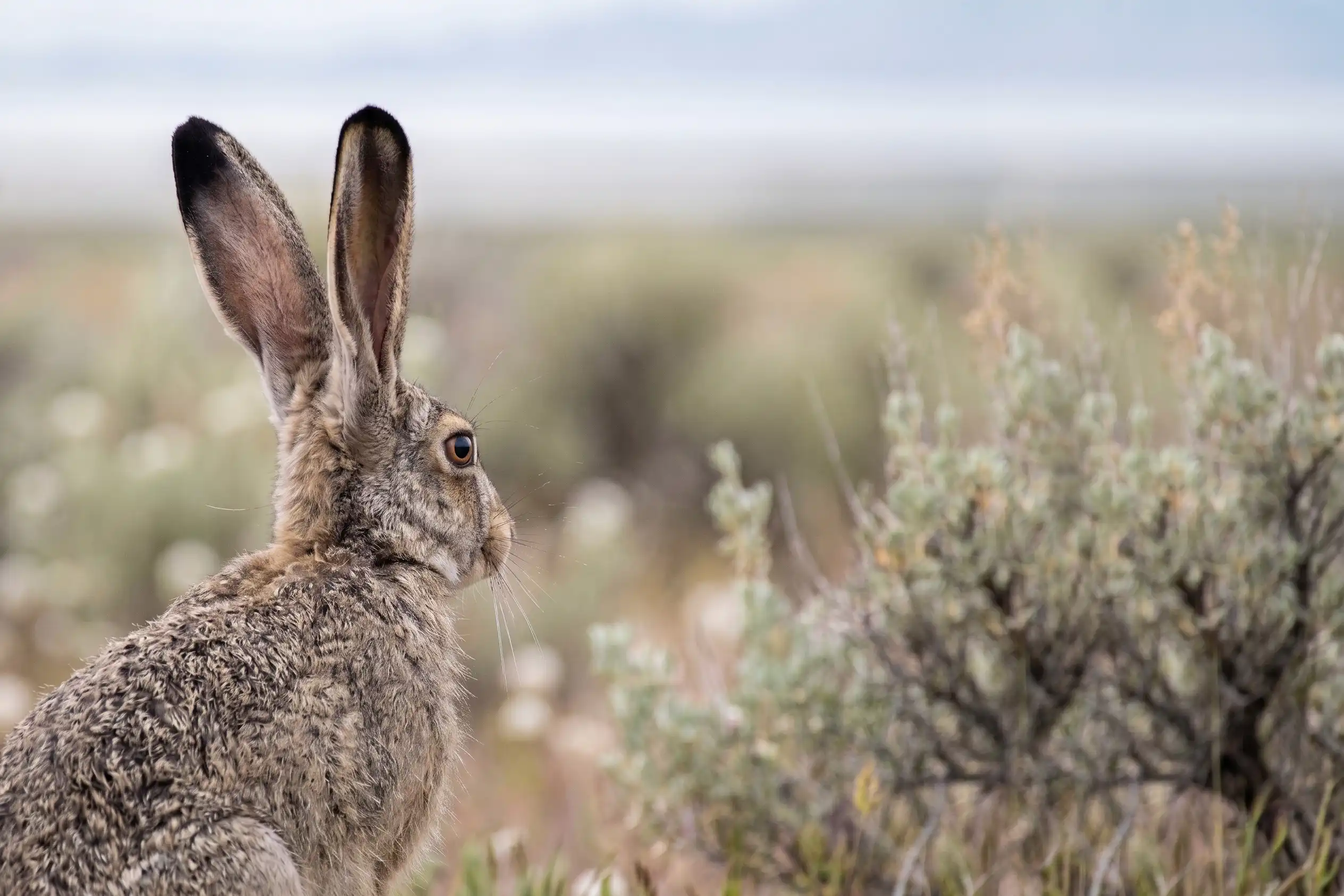
Description: Black-tailed jackrabbits are known for their large ears. They have light brown fur and a black stripe that runs down its back. They have a black tail and black tipped ears. They have skinny front legs and large back feet that can be about 5 inches in length. A jackrabbit isn’t actually a rabbit; they’re hares. They are classified as a hare because their babies are born with fur and their eyes open. Their large ears help lose heat and keeps their body temperature cool.
Fun Facts
- Their eyes are high on their head and towards the side of their head. This gives them the ability to see almost 360 degrees around them.
- They are capable of reaching 40mph and their hind legs can help them reach 10 feet in one bound.
- There are 5 different species of jackrabbits found in central and western North America.
- Baby jackrabbits are called leverets.
Desert Cottontail Rabbit
(sylvilagus nuttallii)
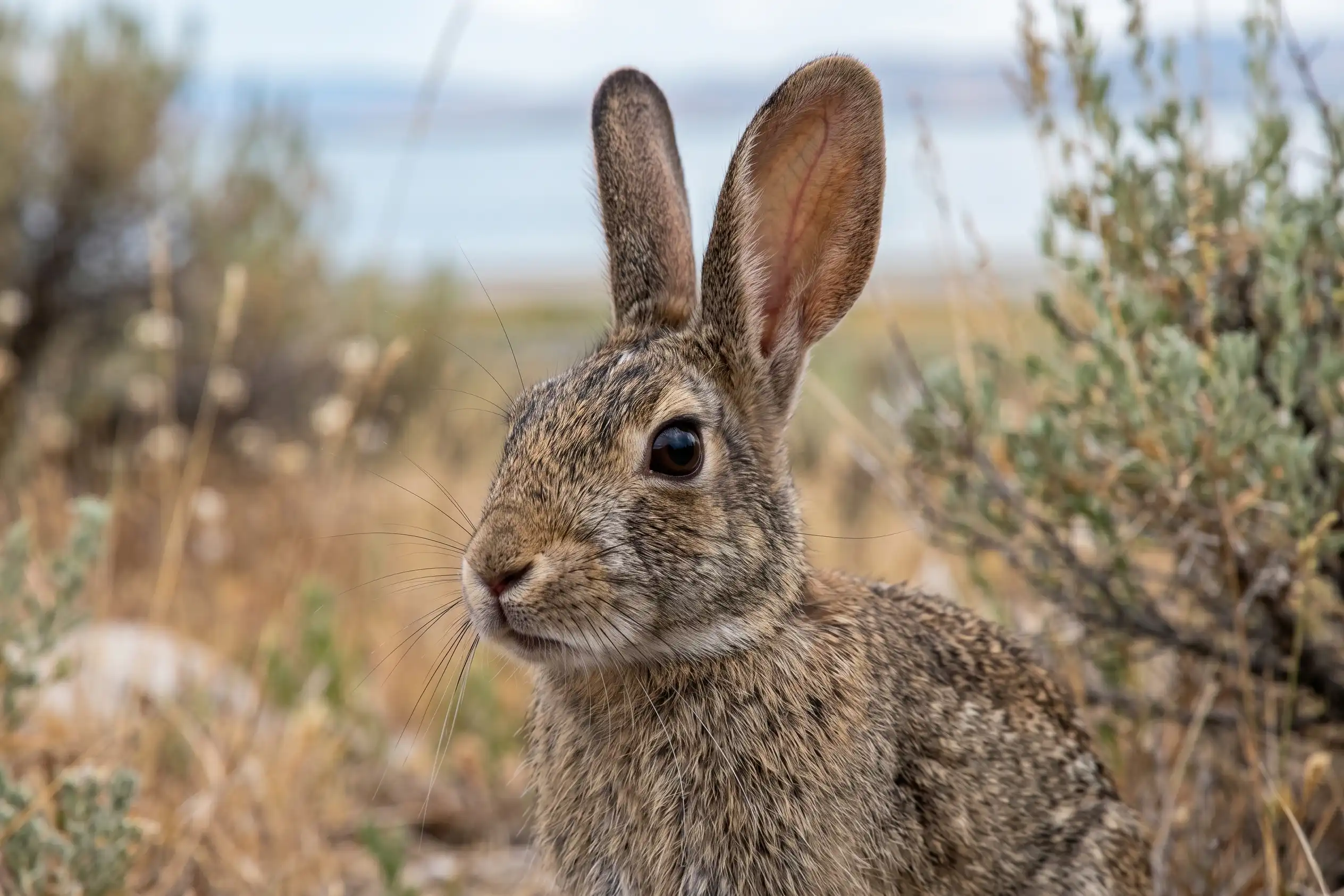
Description: Cottontail rabbits have long ears with black tips. Their ears are about 3 to 4 inches long. They have greyish-brownish fur, used to camouflage with the land around them, and large hind feet. They usually have a patch of orange on their throats. As the name suggests, they do have white, little cotton tails. Rabbits are different from hares because a newborn rabbit is born blind and furless. Hares, like the black-tailed jackrabbit are born with fur and open eyes.
Fun Facts
- When startled, a cottontail can run up to 20mph, in a zig-zag pattern. They will usually run to a hard-to-reach location to hide. If cornered by a smaller predator, they will “bowl over” or somersault and kick the predator with its strong back legs. Sometimes they will sit completely still and try to blend in with its surroundings.
- Cottontails are coprophagic. The grasses can be hard for the cottontails to digest and get the full nutrients. They will eat their own feces in order to retain the full nutrients.
- Cottontails will be more active in the early mornings and late evenings during the summer, along with having large ears and light-colored fur, helps radiate heat into the air, so they don’t overheat.
Meadow Vole
(microtus pennsylvanicus)
Description: Voles look very similar to mice, but they have shorter tails and rounder bodies. Also known as the “meadow mouse” or “field mouse” have coarse hair that can be yellow-brown, red-brown, or black-brown coloring. The fur on their stomach is usually a lighter color. They have short noses and tiny, furry ears.
Fun Facts
- Meadow voles will establish a home range of 0.1 to 1 acre. Males will move beyond this when looking for a mate.
- Meadow voles will eat their body weight in food every day.
- Meadow voles will lie low during a full moon. The full moon provides too much light and increases their risk of being spotted by a hungry predator.
Ord’s Kangaroo Rat
(dipodomys ordii)
Description: Ord’s kangaroo rats have tan/cinnamon colored fur, with a white underside and on parts of the face. Their long tails can be 4 to 6 inches in length. Their tails are mostly furless except a tuft of dark colored fur at the end of the tail. They use their tails as a sort of rudder to help with quick jumps to get out of the way of danger quickly. They are named for their big, strong hindlegs which help them jump, like a kangaroo. Their hind feet are usually white and have 5 toes.
Fun Facts
- Ord’s kangaroo rats have pockets on the outside of their cheeks to store food to take back to their burrow.
- These rats don’t need to drink water, they get plenty of water from the seeds they eat.
- Ord kangaroo rats can jump over 9ft in a single bound.
- They have a great ability to hear the silent sounds of an owl flying high above them.
- They are solitary animals and usually meet other kangaroo rats to mate.
Bobcat
(Lynx rufus)
Description: Bobcats, sometimes called wildcats, are about twice the size of domestic house cats. They are usually brown or reddish-brown with darker colored spots and a white stomach. They have pointed, cat-like ears that have tufts of fur at the end of them. They have very long legs, powerful back legs that tend to have black stripes and large paws. Their back legs are longer than their front legs. The bobcat is named for its black-tipped small “bobbed” tail which is only about 4 to 7 inches long.
Fun Facts
- They can quietly run up to 30mph.
- Their paws act as snowshoes, allowing them to easily walk on top of snow.
- They are nocturnal; active primarily at night.
- Bobcats can jump as high as 12 feet.
Long-Tailed Weasel
(mustela frenata)
Description: Long-tailed weasels look very similar to ferrets. They have long bodies, long tails with a black tip, small legs, and a small head with a long neck. They have small, rounded ears. They usually have red/brown fur on their backs and yellow or white fur on its stomach, chest, and neck. Like a snowshoe hare, they turn white in the winter to blend in with the snow.
Fun facts
- They have been around North America for nearly 2 million years.
- They are good climbers and swimmers.
- They can take down predators much larger than them, but they prefer mice and rabbits.
- Their tail is usually 50 to 70% as long as their body.
- Their eyes are black in daylight, but glow green when a light is shined on them at night.
Raccoon
(procyon lotor)
Description: Raccoons are most famous for their bandit-mask markings around their eyes. They have brown/grayish fur and a tail with black and white rings around it. They have white markings on their short, pointed nose. They are about the size of a house cat. They have pointed ears that stand up, small limbs with long paws. They are extremely adaptable animals who can live just about anywhere. They have dexterous front paws and long fingers that they use like human hands. Raccoons will eat anything they can get their paws on.
Fun facts
- Raccoons eat a lot during spring and summer to build up body fat. They spend most of the winter sleeping in their dens.
- They have adapted well to city life and have become more common in urban areas than anywhere else.
- They use their senses in their paws to help them learn about things. They have 5 times more sensory cells in their paws compared to other mammals. The part of their brain that processes sensory signals devotes 75% of it to the sense of touch.
- Raccoons are incredibly smart and cunning and can easily get into normal garbage cans.
Deer Mouse
(peromyscus maniculatus)
Description: A deer mouse is a small rodent that blends in well with the grassy grounds. Their fur is a tan/brown color with a white belly, chest and chin. Their name comes from their color pattern, making them look similar to a deer. They have long round ears. Their hind legs are much longer than their front legs. They have large black eyes and long, thin tails.
Fun facts
- They are nocturnal.
- They burrow underground, either building their own or inhabiting an empty one.
- Their whiskers allow them to feel temperature changes as well as the surface when moving around.
- Deer mice like to feel clean. They are constantly cleaning their coats.
Striped Skunk
(mephitis mephitis)
Description: Striped skunks are about the size of a domestic cat. They have short legs, a small head, and a bigger body. They are mostly black in color with 2 white stripes starting from their head to their tail, and one thin strip that starts on their face and goes underneath to their chest and stomach. Their tail is a mixture of white and black fur. Skunks are known for their stinky spray. A skunk’s spray is an oily liquid that comes from the glands underneath its tail.
Fun facts
- Skunks are part of the weasel family.
- They are nocturnal.
- Skunks are one of the primary predators of the honeybee and yellowjackets. They will often dig up or find hives and eat the first bees that come out. They rely on their thick fur to keep them safe from bee stings.
- They use this spray as a defense against predators and can reach up to 10ft away.
Coyote
(canis latrans)
Description: They are similar in size to a German Shepard. They have long skinny legs, a bushy tail with a black tip and pointed ears that always stick up. Their fur can be gray, brown or a reddish color. They have big yellow eyes. They have short, pointed noses. Many people mistake them for a wolf, but they are much smaller than wolves.
Fun Facts
- They usually run with their tail down.
- They have up to 11 different vocalizations.
- While they mostly eat meat, they will eat whatever is available to them.
- They can run up to 40mph.
- They usually only have one mate for their entire lives.
- They are found as far north as Canada and as far south as Costa Rica.
- Coyotes self-regulate. Packs have alphas, who manage the size and health of the whole pack. When resources are low, they will restrict mating and terminate pups. We rely on them as one of the only and most important predators on the island.
American Badger
(taxidea taxus)
Description: The American badger has short dark colored legs, a flat body, and a triangular face. They have a long, pointed nose. Their fur is a mix of tan, gray, white and black. They have black/dark brown and white markings on their face. They have a white stripe that starts from their nose and runs all the way down their back. They have small ears on the sides of their head. They have long, sharp front claws. They use these claws to dig for burrowing animals.
Fun facts
- According to UNews, “While studying scavenger behavior in Utah’s Great Basin Desert, University of Utah biologists observed an American badger do something that no other scientists had documented before: bury an entire calf carcass by itself.” This was the first time they discovered that a badger would bury an animal much larger than themselves.
- Coyotes and badgers often team up to hunt. When a badger digs in an already existing burrow, coyotes will catch what tries to escape.
- They have loose fur and skin and muscular necks. If attacked, this makes it easy for them to turn and fight back.
Red Fox
(vulpes fluva)
Description: Red foxes usually have red colored fur, but they can be darker brown, yellow, or even silver. They have pointed ears that stand up straight and have dark-brown markings at the tip of their ears. They usually have shorter dark colored limbs. White fur covers their lower jaw, ears, and chest. They have long bushy dark colored tails that always have a white tip at the end. Their tails help keep them balanced.
Fun facts
- They will use their thick tails as a cover to keep them warm during cold weather and will use them to communicate with other foxes.
- Red foxes have a reputation for being intelligent and cunning.
- They are extremely adaptable and can live just about anywhere.
- Foxes have amazing senses. They can hear small animals underground and under layers of deep snow.
- They are always hunting, even when full. They will save the rest for a later meal.
Bats
Brazilian Free-Tailed Bat
(tadarida brasiliensis)
Description: Brazilian free-tailed bats are a medium sized bat. They have short snouts with wrinkled upper lips. They have brown fur and large ears. They have a tail that extends past the membrane between a bat’s legs. They have strong, pointed wings that help them with rapid, direct flight. They mainly eat moths, dragonflies, flies, bees and other bugs.
Townsend’s Big-Eared Bat
(corynorhinus townsendii)
Description: Townsend’s big-eared bats are medium sized bats. They have light, either grey or brown fur. They have very long ears that can reach about 1.5 inches long. They have two glandular lumps on either side of their nose. These glands produce sebaceous secretions that males use to rub on females to scent mark them after mating.
Little Brown Bat
(myotis lucifugus)
Description: Little brown bats are very small bats. Their fur is dark brown, golden brown, reddish or olive brown. The bottom side is usually a lighter color. They have small, black colored ears, tiny mouths and eyes. Their wings are a very dark brown or black color.
Big Brown Bat
(esptesicus fuscus)
Description: Big brown bats are “big” for a North American bat. They have brown, copper colored fur and lighter colored fur on their belly. They have small, rounded, black colored ears. Their wings are black in color, as well as their face. They have broad noses compared to the rest of their face.
Yuma Myotis
(myotis yumanensis)
Description: They have short, tan/brown fur and lighter fur color on their belly. They have small, pointed ears.They have a small nose and tiny eyes. They have black colored wings.
Long-Eared Myotis
(myotis evotis)
Description: Long-eared myotis are a smaller species of bat. They have light brown or tan colored fur. They have black ears and wings. Their ears are about 0.5 inches long. They have small, dark colored faces. Males are smaller than females.
Western Small-Footed Bat
(myotis ciliolabrum)
Description: Western small-footed bats are smaller bats that have black wings. They have small, pointed, black ears that are about 0.62 inches long. They have a thin, black colored face. Their fur can be light brown to a light, golden color. Named for the foot size, their feet are only about 0.3 inches long.
Canyon Bat
(parastrellus hesperus)
Description: Also known as the western pipistrelle. This is the smallest bat in the United States. They have a small pointed nose, a dark colored face with very small, pointed ears. Their wings are black. Their fur is a golden brown to a tan color.
Silver-Haired Bat
(lasionycteris noctivagans)
Description: The silver-haired bat is a medium sized bat. It has dark brown to black hair that is tipped with silver. The silver hair is primarily on the back of the bat. They have short, rounded ears and a wide nose.
Hoary Bat
(lasiurus cinereus)
Description: They are about the size of a large mouse. They have rounded noses, small eyes, and short, thick, rounded ears. They have thick, long and soft hair that covers the entire body. Their fur is a mix of brown, gray and white, giving them a “frosty” look. They have a tan colored ring around their dark colored faces.
Conditions: View more park conditions
Hours: Open year-round: 6 a.m. – 10 p.m.
Closed: Thanksgiving and Christmas
Phone: 801-725-9263
Visitor Center
Hours: 9 a.m. – 5 p.m.
Fielding Garr Ranch Museum and Exhibit
Facilities Open: Daily 10 a.m. – 5 p.m.
Self-Guided: Outside of open hours
Management
Park Manager: Doranne Pittz
Assistant Park Manager: LeeAnn Burrill

64°F
L: 63°
H: 66°
Feels like 63°F°
clear sky
Daily Forecast
Hourly Forecast
Today
63° / 66°°F
0 mm
0%
9 mph
67 %
1019 mb
0 mm/h